The Legal Window Tint Limits In NSW, And What They Mean For Your Car
Window tint in NSW is governed by exact numbers, and fitting the wrong film to the wrong window buys you a defect notice. Here are the legal limits window by window, why they exist, and how to get the darkest look the law allows.
The short version
- In NSW, the driver and front passenger windows must let through at least 35 percent of visible light.
- Rear side windows and the rear window can go as dark as 20 percent, provided the vehicle has a rear-vision mirror on each side.
- The windscreen cannot be covered in film at all, apart from a band across the top covering no more than 10 percent of its height, or the area above the wiper arc, whichever is greater.
- Tint must not reflect more than 10 percent of light, so mirror finishes are not legal on any window.
- VLT means visible light transmission, so a lower number is a darker window, and film stacks on top of whatever tint the factory glass already carries.
What VLT means, and why lower is darker
Every tint rule in NSW is written in VLT, visible light transmission. It is the percentage of visible light that makes it through the glass and the film together. A window at 100 percent VLT passes everything, a window at 0 percent passes nothing, so the lower the number, the darker the glass. The legal limits are floors, not targets: 35 percent means at least 35 percent of light must get through.
The part that catches people out is that the limit applies to the glass and film combined. Factory glass is never perfectly clear. Put a film rated at 35 percent onto glass that already passes only 80 percent of light and the window as a whole now reads around 28 percent, which is under the front window limit. A proper tinter measures the glass before choosing the film, rather than trusting the number on the roll.
That is also why the test at a registration inspection or a roadside stop is a meter held against your window, not a glance at a receipt. The reading the meter gives is the only number that matters.
It also explains why the same car can legally wear very different films front and back. Plenty of utes and SUVs leave the factory with privacy glass on the rear windows that is already dark, while the front door glass is close to clear. Put the same roll of film on both and the fronts might scrape through while the rears land well under their limit. Each window has to be treated as its own calculation.
The limits, window by window
For the windows beside the driver and front passenger, the minimum is 35 percent VLT. These are the windows you look through for head checks and the ones other drivers, cyclists and pedestrians look into to catch your eye at a crossing, so they get the strictest side-glass rule.
Behind the driver, the rules relax. Rear side windows and the rear window may go down to 20 percent VLT, on the condition that the vehicle has a rear-vision mirror fitted on each side, because heavily tinted rear glass means the interior mirror is doing less of the work. Most modern cars carry twin mirrors as standard, so for most people 20 percent in the back is available.
The windscreen is its own category. No film is allowed on the main field of view at all. The only tint permitted is a visor band across the top, covering no more than 10 percent of the windscreen's height or the area above the arc swept by the wipers, whichever is greater. And across every window, film must not have a reflectance above 10 percent, which rules out mirrored and highly metallic finishes.
All of this comes from the NSW vehicle standards, and Transport for NSW publishes it in plain language in its guide How do I know my windows and window tint are legal in NSW?, with the full detail in the published document. If anyone quotes you different numbers, that guide settles it.
Why the rules sit where they do
The 35 percent front limit is about seeing and being seen. Night driving through dark film means less light reaching your eyes exactly when there is least light to spare, and the people sharing the road with you lose the ability to make eye contact with the driver. The rear of the car affects other road users less, which is why it is allowed darker.
The reflectance cap works the same way in reverse. A mirrored window throws glare at whoever is beside or behind you, and headlights bouncing off a reflective rear window at night are a hazard the standards simply do not allow.
It helps to remember that the rules apply whenever the car is on the road, not only on inspection day. The head check over your shoulder before a lane change, the glance through the passenger window at a give way sign at dusk, the pedestrian at a crossing trying to work out whether you have seen them: those are the moments the limits were written for, and they all happen through the front glass.
Buying a car that is already tinted
Tint belongs to the car, not the person who paid for it. If you buy a used car wearing 15 percent film on the front doors, the defect is now yours, and it will surface at the next inspection or the next time a meter comes out. It is worth checking before you buy, because stripping old film and re-tinting legally is a cost the sale price should reflect.
What too-dark tint costs you
Non-compliant tint is a vehicle defect. That can mean a defect notice at a roadside stop, a failed inspection when registration comes around, and an order to remove the film before the car is cleared. The film itself is destroyed in removal, so the money spent on an illegal tint is gone, and the window gets done twice.
The frustrating part is how unnecessary it is. On most cars, legal film fitted well gets you the look people are actually after. A quality 35 percent film on the front with 20 percent behind the driver reads as a properly dark car from the street, without the meter ever being a worry.
The most common way people end up on the wrong side of the line is not asking for something outrageous, it is stacking. A dark film over factory privacy glass, or a second layer over old tint that was never stripped, quietly drags the combined reading under the limit even though each layer sounds reasonable on its own. It is one of the first things we check when a car arrives already wearing film.
What tint does for heat, glare and the cabin
Dark film is not just cosmetic. Tint cuts glare on the long western runs into the afternoon sun, keeps a parked cabin cooler, and reduces the solar load that fades dash tops and dries out leather. In a region that cops as much summer sun as Western Sydney, the rear seats and the child seat in them are the obvious beneficiaries of 20 percent glass behind the driver.
Quality matters more than darkness here. Films vary enormously in how much heat they reject at the same VLT, which is another reason the cheapest roll is rarely the right answer. Ask what film is going on, not just what shade.
The sun that cooks the cabin is the same sun working on the paint outside, and out this way it does both harder than most of the country. We covered what Western Sydney summers actually do to a car's exterior in our post on sun damage, and the short version applies inside the glass as well: the car that gets protected early is the one that still looks right in five years.
Tint and PPF are different jobs
People often ask for both in the same breath, and they solve different problems. Tint manages light and heat through the glass. Paint protection film is a clear urethane layer over the paint that takes stone chips and scratches so the paint does not. One protects the cabin and your eyes, the other protects the panels.
How we fit tint at Detail Hub
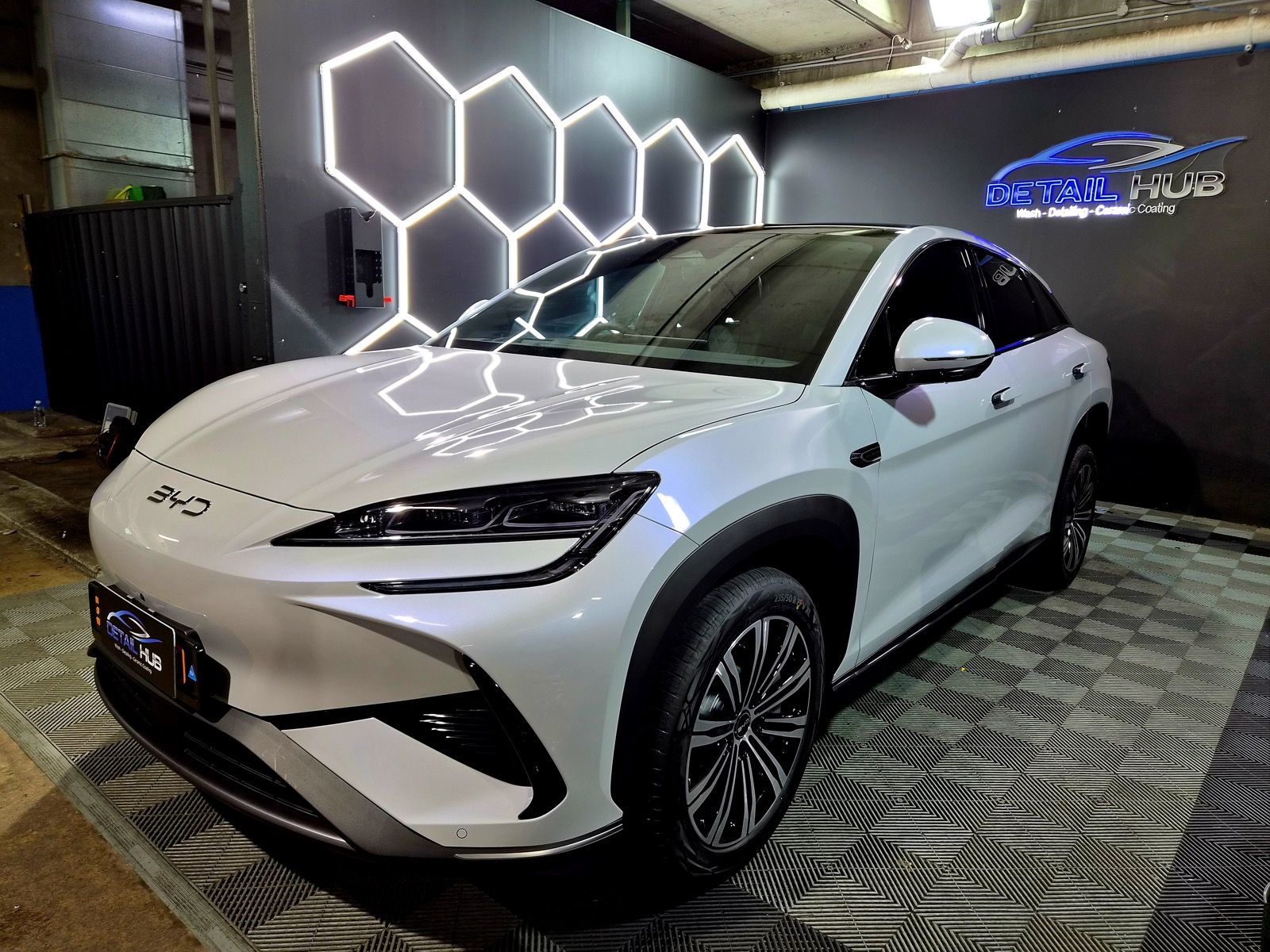
Our window tinting is done in the workshop at Pemulwuy, with the car inside and the glass cleaned and decontaminated before any film goes near it. Film is cut to the window, edges are finished properly, and the shades we fit are chosen window by window so the car leaves compliant: 35 percent capable film on the front doors, darker options behind the driver where the mirrors allow it.
Because tinting sits alongside the rest of our detailing services, the glass work can be booked with a detail or a coating in the same visit, and plenty of customers from Merrylands, Greystanes and the surrounding suburbs do exactly that.
The question we ask before cutting film
It is always the same one: what is the car for? A family SUV that lives outside wants heat rejection in the back. A work ute wants durability. A weekend car wants optics. The legal limits are fixed, but inside them there are real choices, and five minutes of questions beats re-doing a window.
Aftercare is part of the job too. Freshly fitted film needs the windows kept up while the mounting solution dries out, and a light haze or a few small moisture pockets in the first days are a normal part of curing, not a fault. We walk every customer through what to expect before the car leaves, so nobody is surprised by a window that looks slightly cloudy on day two and perfect by the weekend.
Where to start
If the car needs tint, or it is wearing film you suspect is on the wrong side of the limits, send us a message or give us a call. Quotes are free, we are open 8am to 5pm seven days, and we will tell you exactly what shade each window can legally carry before any film is cut.